

Migrating Under Suspicion: Crimigration, Borders, and Human Security
Article Sidebar
Estadísticas de artículo
Main Article Content
Abstract
In this interview, Martina Cociña-Cholaky analyzes the main challenges of migration governance in Chile and Latin America from a critical human rights perspective. The conversation addresses the relationship between migration, security, and border control; the rise of “crimigration”; the militarization of Chile’s northern border; the practice of forced return; the use of surveillance technologies and biometric registration; and the uncertainty faced by undocumented migrants. She also reflects on the limits of “heavy-handed” state responses, the portrayal of migrants as a threat, and the need to rethink sovereignty from the perspective of human security, regularization, and the effective protection of rights.
Downloads
Article Details
How to Cite
Issue
License
Copyright (c) 2026 Martina Cociña-Cholaky
CC BY-NC-SA. This license allows sharing, copying, distributing, performing, and publicly communicating the work, as well as creating derivative works.
Author Biography
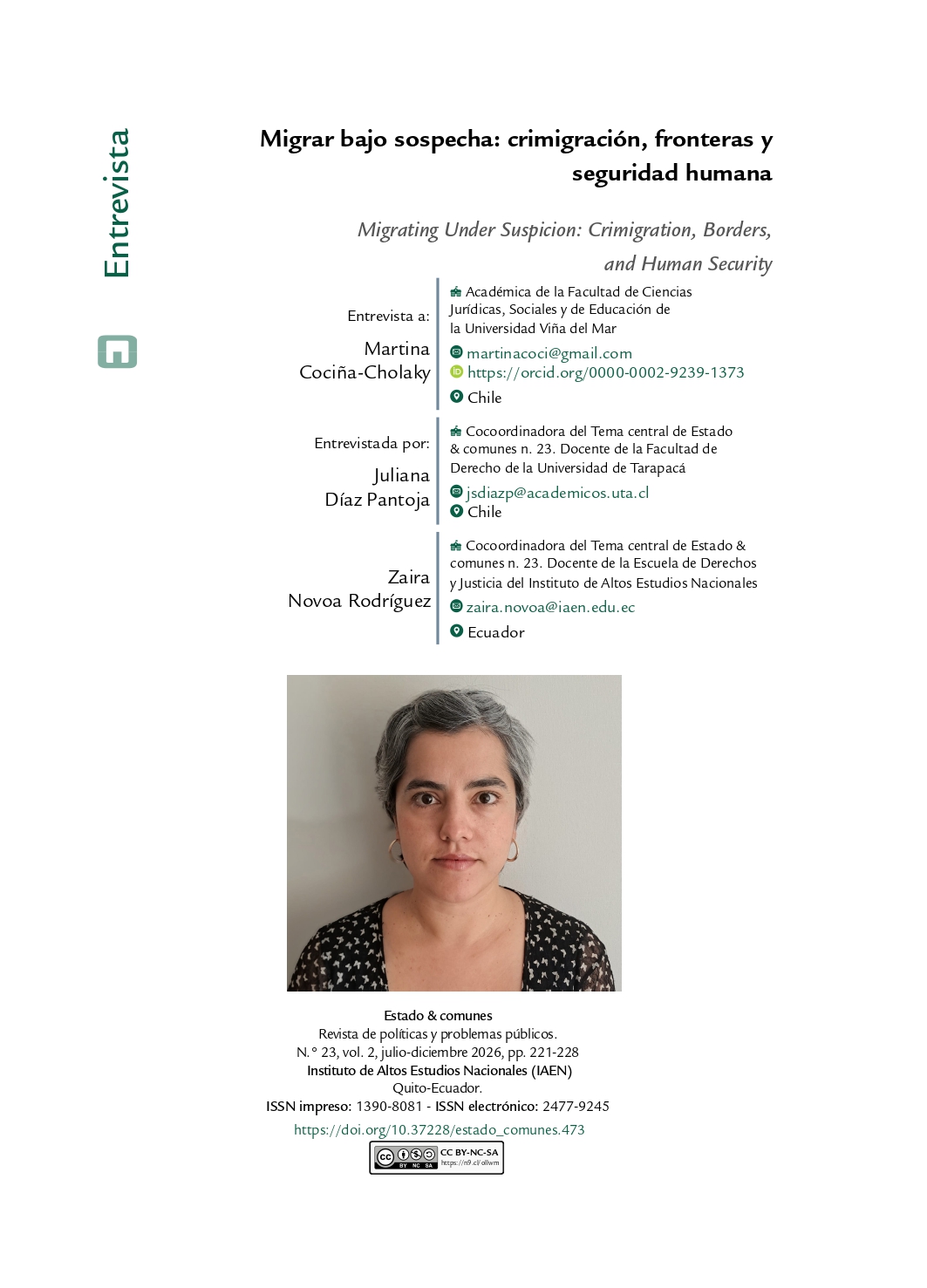
Martina Cociña-Cholaky (Universidad de Viña del Mar)
She holds a law degree from the University of Chile, a master’s degree in Criminology, Criminal Policy, and Legal-Criminal Sociology, and a Ph.D. in Law and Political Science from the University of Barcelona. She is a faculty member and professor at the University of Viña del Mar, and a postdoctoral researcher at the Institute of Social Sciences at O’Higgins State University. Her professional career has focused on university teaching, academic research, and participation in specialized networks on migration, asylum, and human rights. She is the principal investigator for Fondecyt Postdoctoral Grant 3230279, focused on the right to asylum in Chile, and for Fondecyt Initiation Grant 11260814, concerning the use of technology in immigration control. She is also a member of academic networks linked to the Network of Universities for Migration.