

Beyond Seizures and Narratives of a “Heavy Hand”: Criminal Governance, Interdependence, and Illicit Economies
Article Sidebar
Estadísticas de artículo
Main Article Content
Abstract
In this interview, Renato Rivera argues that the use of the armed forces and the “iron fist” policy have failed to reduce the supply of cocaine and homicides in the region and that, on the contrary, they are on the rise. He highlights the evolution of the concepts of cartels to criminal groups and internal security to citizen security, as well as efforts in Peru and Colombia to measure the impact of drug trafficking on the national economy. Renato points out that illicit crops are present in Central America, that fentanyl consumption in the region is not as significant as in the United States, and that since 2016, regional interdependence in cocaine trafficking between Colombia, Ecuador, and Mexico has been reinforced.
Downloads
Article Details
How to Cite
Issue
License
Copyright (c) 2026 Renato Rivera Rhon
CC BY-NC-SA. This license allows sharing, copying, distributing, performing, and publicly communicating the work, as well as creating derivative works.
Author Biography
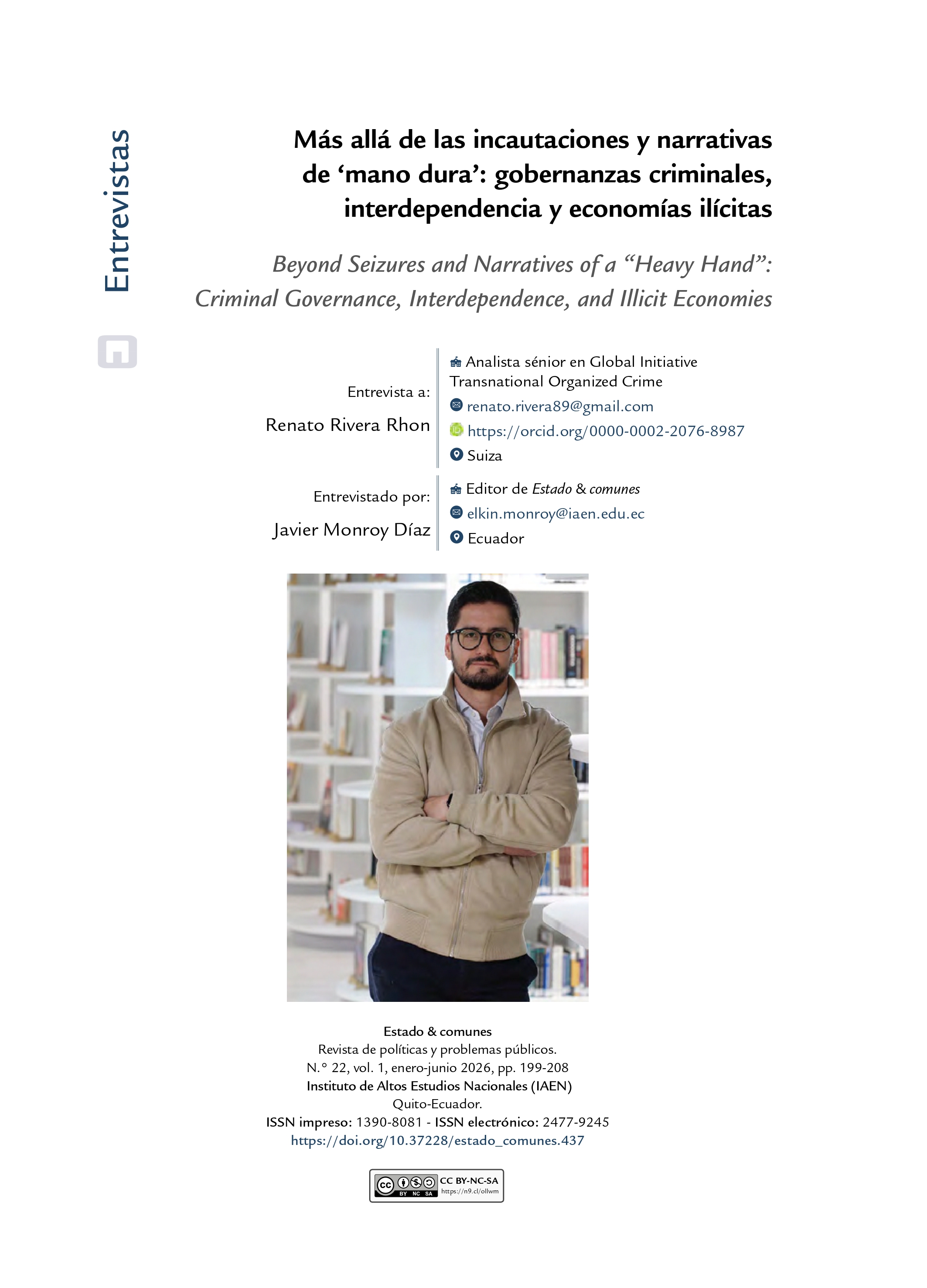
Renato Rivera Rhon (Global Initiative Transnational Organized Crime)
PhD in Rule of Law and Global Governance from the Universidad de Salamanca. He holds two master's degrees: one in International Relations from the Barcelona Institute of International Studies and the other in International Studies from Flacso-Ecuador. Member of the Red Latinoamericana de Análisis de Seguridad y Crimen Organizado, as well as a consultant and researcher specializing in organized crime, security policies, and illicit economies. He was coordinator and then director of the EObservatorio Ecuatoriano de Crimen Organizado, a professor at the Universidad de las Américas, Flacso-Ecuador, and the Instituto de Altos Estudios Nacionales. He currently serves as a senior researcher affiliated with the Global Initiative Against Transnational Crime.